Number of NaNoWriMo novel words written today: 160.
 |
Barton Fink failing to write failing to write |
|
| Barton Fink failing to write |
 |
| Miguel de Unamuno at his desk |
 , which was accidentally burned by John Stuart Mill's maid, forcing Carlyle to rewrite the whole thing from scratch.
The language used, the opinions given, the approvals and objections engendered by one's work happen in a sense outside one's actual experience of it, since the core of that experience consists in writing the stuff. I have a particular relationship with the words I put down on paper and the characters which emerge from them which no one else can share with me...
I believe myself that when a writer looks at the blank of the word he has not yet written, or when actors and directors arrive at a given moment on stage, there is only one proper thing that can take place at that moment, and that that thing, that gesture, that word on the page, must alone be found, and once found, scrupulously protected...

...You create the word and in a certain way the word, in finding its own life, stares you out, is obdurate, and more often than not defeats you. You create the characters and they prove to be very tough. They observe you, their writer, warily...
I am aware, sometimes, of an insistence in my mind. Images, characters, insisting upon being written. You can pour a drink, make a telephone call or run round the park, and sometimes succeed in suffocating them. You know they're going to make your life hell. But at other times they're unavoidable and you're compelled to try to do them some kind of justice. And while it may be hell, it's certainly for me the best kind of hell to be in.
 |
| J. M. Coetzee writing |
We all like to pretend we don’t use real people, but one does actually. I used some of my family... In no book have I got down more than the people I like, the person I think I am, and the people who irritate me. This puts me among the large body of authors who are not really novelists and have to get on as best they can with these three categories. We have not the power of observing the variety of life and describing it dispassionately. There are a few who have done this. Tolstoy was one, wasn’t he?

 |
| John Gardner writing |
 ) so I am able to move about the various sections a little more freely.
 |
“I did not believe political directives could be successfully applied to creative writing . . . not to poetry or fiction, which to be valid had to express as truthfully as possible the individual emotions and reactions of the writer.” - Langston Hughes

 |
| Gabriel Garcia Marquez at his desk |
My theory for years has been to write fast and get through it. I usually write five pages a night and leave them out for my assistant to type in the morning.[asked about writers who claim they can't write under the influence of drugs or alcohol]
They lie. Or maybe you've been interviewing a very narrow spectrum of writers. It's like saying, “Almost without exception women we've interviewed over the years swear that they never indulge in sodomy”—without saying that you did all your interviews in a nunnery. Did you interview Coleridge? Did you interview Poe? Or Scott Fitzgerald? Or Mark Twain? Or Fred Exley? Did Faulkner tell you that what he was drinking all the time was really iced tea, not whiskey? Please. Who the fuck do you think wrote the Book of Revelation? A bunch of stone-sober clerics?

 ]
][...] something else was written first, chronologically, but when I wrote that . . . well, there are moments . . . a lot of them happen when nothing else is going right . . . when you're being evicted from the hotel a day early in New York or you've just lost your girlfriend in Scottsdale. I know when I'm hitting it. I know when I'm on. I can usually tell because the copy's clean. [...] I never sit down and put on my white shirt and bow-tie and black business coat and think, Well, now's the time to write. I will simply get into it. [...] I'd say on a normal day I get up at noon or one. You have to feel sort of overwhelmed, I think, to start.
You've got to be able to have pages in the morning. I measure my life in pages. If I have pages at dawn, it's been a good night. There is no art until it's on paper, there is no art until it's sold. If I were a trust-fund baby, if I had any income from anything else . . . even fucking disability from a war or a pension . . . I have nothing like that, never did. So, of course, you have to get paid for your work. I envy people who don't have to . . .

 |
| F. Scott Fitzgerald writing |
 |
| John O'Hara at his desk |
When I write, I do not think of the reader (because the reader is an imaginary character), and I do not think of myself (perhaps I am an imaginary character also), but I think of what I am trying to convey and I do my best not to spoil it... When I am writing something, I try not to understand it. I do not think intelligence has much to do with the work of a writer...

When I write (of course, I may not be a fair example, but merely an awful warning), I try to forget all about myself. I forget about my personal circumstances. I do not try, as I tried once, to be a “South American writer.” I merely try to convey what the dream is. And if the dream be a dim one (in my case, it usually is), I do not try to beautify it, or even to understand it.

 |
| George Orwell Writing |
"All writers are vain, selfish, and lazy, and at the very bottom of their motives there lies a mystery. Writing a book is a horrible, exhausting struggle, like a long bout of some painful illness. One would never undertake such a thing if one were not driven on by some demon whom one can neither resist nor understand."
 |
| Roland Barthes at his desk |

"I feel that life is divided into the horrible and the miserable. That's the two categories. The horrible are like, I don't know, terminal cases, you know, and blind people, crippled. I don't know how they get through life. It's amazing to me. And the miserable is everyone else. So you should be thankful that you're miserable, because that's very lucky, to be miserable."
When I'm writing, I write every day. It's lovely when that's happening. One day dovetailing into the next. Sometimes I don't even know what day of the week it is. The “paddle-wheel of days,” John Ashbery has called it. When I'm not writing, like now, when I'm tied up with teaching duties as I have been the last while, it's as if I've never written a word or had any desire to write. I fall into bad habits. I stay up too late and sleep in too long. But it's okay. I've learned to be patient and to bide my time. I had to learn that a long time ago. Patience. If I believed in signs, I suppose my sign would be the sign of the turtle. I write in fits and starts. But when I'm writing, I put in a lot of hours at the desk, ten or twelve or fifteen hours at a stretch, day after day. I love that, when that's happening. Much of this work time, understand, is given over to revising and rewriting. There's not much that I like better than to take a story that I've had around the house for a while and work it over again. It's the same with the poems I write. I'm in no hurry to send something off just after I write it, and I sometimes keep it around the house for months doing this or that to it, taking this out and putting that in. It doesn't take that long to do the first draft of the story, that usually happens in one sitting, but it does take a while to do the various versions of the story. I've done as many as twenty or thirty drafts of a story. Never less than ten or twelve drafts. It's instructive, and heartening both, to look at the early drafts of great writers. I'm thinking of the photographs of galleys belonging to Tolstoy, to name one writer who loved to revise. I mean, I don't know if he loved it or not, but he did a great deal of it. He was always revising, right down to the time of page proofs. He went through and rewrote War and Peace eight times and was still making corrections in the galleys. Things like this should hearten every writer whose first drafts are dreadful, like mine are.
 |
| Raymond Carver writing |
I write the first draft quickly, as I said. This is most often done in longhand. I simply fill up the pages as rapidly as I can. In some cases, there's a kind of personal shorthand, notes to myself for what I will do later when I come back to it. Some scenes I have to leave unfinished, unwritten in some cases; the scenes that will require meticulous care later. I mean all of it requires meticulous care—but some scenes I save until the second or third draft, because to do them and do them right would take too much time on the first draft. With the first draft it's a question of getting down the outline, the scaffolding of the story. Then on subsequent revisions I'll see to the rest of it. When I've finished the longhand draft I'll type a version of the story and go from there. It always looks different to me, better, of course, after it's typed up. When I'm typing the first draft, I'll begin to rewrite and add and delete a little then. The real work comes later, after I've done three or four drafts of the story. It's the same with the poems, only the poems may go through forty or fifty drafts. Donald Hall told me he sometimes writes a hundred or so drafts of his poems. Can you imagine?
 |
| Ralph Ellison at his desk |
 was written as part of NaNoWriMo, but that's not what I'm talking about. Hemingway wrote the first draft of The Sun Also Rises
 in six weeks; Nabokov, after having the idea in his head for a long time, rushed to write Pnin through the summer of 1955. I specifically named those two since they have additional characteristics in common with my work-in-progress, and so give me hope that I could actually breeze my way through a first draft in a relatively short period of time.
  |
| Vladimir Nabokov writing |
 which are now also available online (and included on Donald Barthelme's reading list)
[a writer] must never be satisfied with what he does. It never is as good as it can be done. Always dream and shoot higher than you know you can do. Don't bother just to be better than your contemporaries or predecessors. Try to be better than yourself. An artist is a creature driven by demons. He doesn't know why they choose him and he's usually too busy to wonder why. He is completely amoral in that he will rob, borrow, beg, or steal from anybody and everybody to get the work done...
The writer's only responsibility is to his art. He will be completely ruthless if he is a good one. He has a dream. It anguishes him so much he must get rid of it. He has no peace until then. Everything goes by the board: honor, pride, decency, security, happiness, all, to get the book written. If a writer has to rob his mother, he will not hesitate; the “Ode on a Grecian Urn” is worth any number of old ladies...
 |
| William Faulkner Writing |
The writer doesn't need economic freedom. All he needs is a pencil and some paper. I've never known anything good in writing to come from having accepted any free gift of money. The good writer never applies to a foundation. He's too busy writing something. If he isn't first rate he fools himself by saying he hasn't got time or economic freedom. Good art can come out of thieves, bootleggers, or horse swipes. People really are afraid to find out just how much hardship and poverty they can stand. They are afraid to find out how tough they are. Nothing can destroy the good writer. The only thing that can alter the good writer is death. Good ones don't have time to bother with success or getting rich...
Let the writer take up surgery or bricklaying if he is interested in technique. There is no mechanical way to get the writing done, no shortcut. The young writer would be a fool to follow a theory. Teach yourself by your own mistakes; people learn only by error. The good artist believes that nobody is good enough to give him advice. He has supreme vanity. No matter how much he admires the old writer, he wants to beat him.
 |
| Roberto Bolaño at his desk |
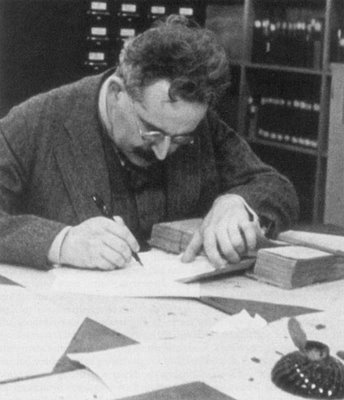 |
| Walter Benjamin writing |
"Writing is not necessarily something to be ashamed of, but do it in private and wash your hands afterwards." - Robert A. Heinlein

"The writer's only responsibility is to his art... Everything goes by the board: honor, pride, decency, security, happiness, all, to get the book written."

Back in Lancashire I got an attack of claustrophobia and tried to convince Mother to let me go and study painting in London. She thought this was a very idle and silly idea and gave me a lecture about artists. “There is nothing wrong about painting,” she told me. “I paint boxes myself for jumble sales. There is a difference though in being artistic and in actually being an artist. Your aunt Edgeworth wrote novels and was very friendly with Sir Walter Scott but she would never have called herself ‘an artist.’ It wouldn’t have been nice. Artists are immoral they live together in attics, you could never get used to an attic after all the luxury and comfort you have here. Besides what is there to prevent you painting at home, there are all sorts of picturesque nooks which would be delightful to paint.”
“I want to paint nude models,” I said. “You can’t get nude models here.”
“Why not?” replied mother with a flash of logic. “People are nude everywhere if they haven’t got any clothes on.” Finally I did go to London to study art and had a love affair with an Egyptian. A pity I never actually got to Egypt but thanks to mother I did see most of Europe during my youth.
 |
| René Magritte. The Portrait. Brussels 1935. |
Art in London didn’t seem quite modern enough and I began to want to study in Paris where the Surrealists were in full cry. Surrealism is no longer considered modern today and almost every village rectory and girl’s school have surrealist pictures hanging on their walls. Even Buckingham Palace has a large reproduction of Magritte’s famous slice of ham with an eye peering out. It hangs, I believe, in the throne room. Times do change indeed. The Royal Academy recently gave a retrospective exhibition of Dada art and they decorated the gallery like a public lavatory. In my day people in London would have been shocked. Today the Lord Mayor opened the exhibition with a long speech about twentieth-century masters and the Queen Mother hung a wreath of gladiola on a piece of sculpture called “Navel” by Hans Arp.
 , Leonora Carrington, 1974.
“With Kafka, people go crazy about getting the original manuscript — not a photocopy, not a facsimile,” Meir Heller [attorney for Israel's National Library] once remarked to me. “With most writers, once there’s a copy, nobody cares.” We fetishize the original manuscripts, because they seem to offer some access to a definitive Kafka — a Kafka beyond Brod. But this, too, is an illusion. The manuscripts aren’t definitive, because definitiveness, for better or worse, is the product of deadlines and editors and publishers: things Kafka either went out of his way not to have or ended up not having because of bad luck, tuberculosis and the First World War. When Kafka did prepare manuscripts for publication, he spent much time correcting mistakes and decoding his own abbreviations, sometimes even enlisting Brod’s help; one critic thus speculates that “Brod’s version might, in the end, look more like what Kafka would have published” than the most meticulous German scholarly editions. Maybe there is no Kafka beyond Brod.
 |
| Illustration by Carin Goldberg. |
 , and, to a slightly lesser extent, Flowers of Evil
 ) I decided to explore some more 19th century French poetry, particularly the works of Arthur Rimbaud
 and Stéphane Mallarmé
 (both in the Oxford World's Classics editions of their complete works) but in both cases I found myself in the same position I often find myself when reading poetry - confused and slightly bored. It was quite disappointing to find that the works of Rimbaud, the great romantic figure, the restless enfant terrible, did not strike me as anything extraordinary, and that the works of Mallarmé, who is considered such a influential innovator, seemed so run-of-the-mill and uninspired to me. Both lacked the passion and wit I found in Baudelaire (it's possible the translations are partially to blame; Mallarmé is notoriously hard to translate, but however he's translated many of his poems are still just drawn-out descriptions, or semi-witty dedications inscribed on fans).
 , Carver's collection All of Us
 , Ginsberg's Howl
 and Kaddish
 , some Coleridge
 and some Borges
 ) and how meaningful those works have been for me, and inevitably pick up another collection (and of course, once I pick up a book I must finish it; it's a sickness, really). Next on my poetry list - Yeats
 , Mayakovsky
 , and Milosz
 . Wish me luck.
 don't really work as novels, and are only interesting for their idiosyncratic components, not the overarching plot which tends to be rather pedestrian. Given this I was somewhat optimistic when approaching Carroll's short works, hoping to find the same wit and whimsy there, and while I certainly didn't suffer in their reading (a compliment I cannot give some of Mallarmé's longer prose-poems) I still came away mildly disappointed. excluding the poems which constitute parts of the Alice books (like "Jabberwocky" and "The Walrus and the Carpenter") , Lewis Carroll wrote two more longish nonsense poems - "The Hunting of the Snark" and "Phantasmagoria" - and 30 other short poems, half of them whimsical and half of them serious.
 and The Heart is Katmandu
 ) I can safely say that he is not my cup of tea - and "cup of tea" is a pretty good metaphor for his writing, it's very much like a dainty little porcelain cup of tea whose meaning lies not in content but in form, meant to convey culture, refinement and, above all, preciousness. If I wished to be a little less gentle in my review I could borrow the infamous title given to a 2005 Pitchfork review of indie pop - Twee as Fuck.
 as the only woman writer on my list. I have, however, been hearing good things about Ronit Matalon, so there's always hope.
 , by Ford Madox Ford, number 30 on the Modern Library's 100 best novels of the 20th century, is one of the dullest books I've ever read. It's kind of like a Henry James story - entirely concerned with the relationships between two wealthy and deceptive couples - as told by an unsympathetic and obtuse narrator. The characters are mostly annoying, the pacing lethargic, and the revelations unrevelatory. So once again I have to question my goal of reading the complete list of "best novels" as chosen by the Modern Library - of the 30 I've read so far 4 have been outright disappointments and 5 have been overrated, which I guess isn't that bad statistically, but the bad ones were really bad, and often placed in ridiculously high places (The Good Soldier appears in the list ahead of A Clockwork Orange
 , Portnoy's Complaint
 , Pale Fire
 , and anything by Hemingway)
 , number 8 on David Pringle's list of the 100 best Science Fiction novels (which I only mention since this whole post seems to gravitate towards lists) is a pretty good book which suffers a little from strict adherence to its genre. As with most dystopian novels, the ideas are more interesting than the execution - firemen employed at burning books, secret groups memorizing whole books to preserve them, pervasive interactive media used to sedate the masses (including an early version of reality TV) are all interesting ideas which are not explored fully.
 , where all the horrific elements are logical expressions of the oppressive regime, here they all seem cobbled together somewhat haphazardly, which may be more realistic, but also dilutes the overall message of the text. There's a long chase scene towards the end of the novel which I found a little too pulpy, as if Bradbury had to inject some typical sci-fi action into the narrative - which made me think of the terrible slasher movie ending tacked on to Danny Boyle's otherwise interesting movie Sunshine - but thankfully the book goes on to explore more aspects of the world Bradbury created and has a far more satisfying ending.


![Darkness at Noon [Books That Have Changed Man's Thinking]](https://images.gr-assets.com/books/1327243764s/13349640.jpg)


 Posts
Posts

